Amazon KDP SEO Strategy Guide: Mastering the 7 Backend Keyword Blueprint
In today's digital marketplace, visibility is everything. For authors and publishers leveraging Amazon KDP (Kindle Direct Publishing), standing out among millions of books can feel like an uphill battle. Many self-publishers struggle with low rankings despite producing quality content. The key to unlocking greater visibility on Amazon lies in a feature often misunderstood — the 7 backend keyword boxes. This guide explores how to use them effectively through the 7 Backend Keyword Blueprint Workbook, a structured approach that turns confusion into clarity.
The Amazon KDP SEO Strategy Guide isn't just another marketing tactic; it's a comprehensive framework that helps creators understand how Amazon's algorithm interprets search intent and ranks content. As more people turn to online platforms for reading material, mastering these strategies becomes essential for anyone serious about publishing on Amazon.
Why Backend Keywords Matter More Than Ever
With over 3 million books available on Amazon Kindle, competition is fierce. Traditional front-end title and description optimization is necessary but not sufficient. Amazon’s search engine heavily relies on the seven backend keyword fields to determine which books appear in search results. These hidden fields are your secret weapon for improving discoverability without compromising the reader experience.
Many authors mistakenly fill these boxes with random keywords or keyword stuffing, which can backfire and even lead to penalties. The 7 Backend Keyword Blueprint Workbook provides a step-by-step process to avoid these pitfalls and strategically select high-impact phrases that align with buyer intent.
Understanding How Amazon Reads Backend Keywords
Amazon’s algorithm doesn’t read keywords in isolation; it considers context, relevance, and user behavior. The Amazon KDP SEO Strategy Guide explains how to structure each of the seven backend keyword boxes to reflect natural language patterns and real-world search queries.
- Use one full search phrase per box: Instead of scattering fragmented terms, focus on complete phrases that readers might type into the search bar.
- Avoid keyword stuffing: Overloading the boxes with irrelevant or repeated terms can harm your book's ranking.
- Structure buyer-intent phrases correctly: Think about what potential buyers are looking for and craft keywords around those needs.
This method ensures that your book appears in relevant searches while maintaining a natural flow that Amazon favors.
Creating a Ranking Loop That Compounds Over Time
SEO isn't a one-time task. It requires ongoing effort and refinement. The 7 Backend Keyword Blueprint Workbook introduces the concept of a "ranking loop" — a strategy that builds upon itself over time. By aligning your backend keywords with your book's description, ads, and other promotional materials, you create a cohesive presence that enhances your book's visibility across multiple touchpoints.
Additionally, the workbook emphasizes the importance of auditing and updating your keywords every six months. Trends change, and so do search behaviors. Regularly revisiting your keyword strategy ensures that your book remains competitive in a dynamic market.
Applying the Strategy Across Different Book Formats
The Amazon KDP SEO Strategy Guide is not limited to fiction. Whether you're publishing nonfiction, journals, workbooks, or low-content books, the principles remain consistent. The 7 Backend Keyword Blueprint Workbook includes practical examples tailored to different genres and formats, making it a versatile tool for any author.
For instance, a journal might benefit from keywords related to personal development, while a workbook could focus on actionable steps and solutions. Understanding these nuances allows you to optimize your content for the right audience.
Real-World Examples and Case Studies
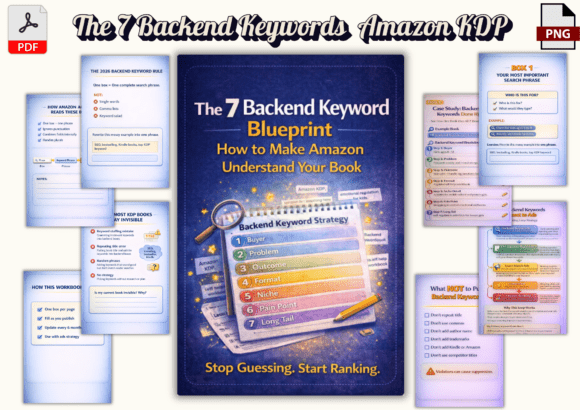
To make the concepts tangible, the 7 Backend Keyword Blueprint Workbook includes a fully filled-out case study. This example walks you through the entire process, from initial research to final implementation, showing how a well-executed keyword strategy can elevate a book's position in search results.
Inside the workbook, you'll also find:
- Clear explanation pages that break down complex ideas into digestible sections.
- Fill-in-the-blank keyword strategy templates to help you customize your approach.
- 7-box breakdown with examples that illustrate best practices.
- Backend keyword audit sheet to evaluate your current strategy and identify areas for improvement.
- Master reusable template page that can be used for future projects.
- Rapid keyword planning worksheet for quick optimization sessions.
- Final strategy summary page that reinforces key takeaways.
These tools empower you to take control of your Amazon KDP SEO efforts and build a sustainable publishing career.
Why Now Is the Right Time to Optimize Your Amazon KDP Strategy
As consumer habits continue to shift toward digital content consumption, optimizing your Amazon KDP strategy has never been more critical. With more readers relying on search engines to find new books, understanding how to leverage backend keywords gives you a significant advantage.
Moreover, the 2026 strategy update included in the 7 Backend Keyword Blueprint Workbook reflects the latest changes in Amazon's algorithm, ensuring that your efforts are aligned with current best practices. This forward-looking approach helps you stay ahead of the curve and maintain a strong presence on the platform.
Whether you're a seasoned author or just starting out, investing in a solid SEO strategy can transform your publishing journey. The Amazon KDP SEO Strategy Guide and its accompanying workbook provide the tools and insights needed to navigate the complexities of Amazon SEO and achieve long-term success.
Conclusion
Mastering Amazon KDP SEO requires more than just knowing the basics. It demands a strategic, repeatable framework that aligns with both algorithmic preferences and user intent. The 7 Backend Keyword Blueprint Workbook offers exactly that — a proven method for optimizing your book's visibility and driving more sales.
By following the principles outlined in the Amazon KDP SEO Strategy Guide, you can unlock the full potential of your content and connect with the right audience at the right time. Don’t let your book get lost in the noise. Take action today and start seeing results tomorrow.