500 Teaching Smarter with AI Prompts
In today’s fast-paced educational environment, teachers are constantly looking for ways to streamline their workflow, enhance lesson quality, and reduce stress. Enter 500 Teaching Smarter with AI Prompts, a practical, teacher-focused resource that leverages the power of artificial intelligence to support educators in planning lessons, creating content, managing classrooms, and growing professionally. This all-in-one prompt book is designed to meet real classroom needs—saving time, reducing workload, and helping teachers focus on meaningful teaching and learning.
What’s Inside 500 Teaching Smarter with AI Prompts
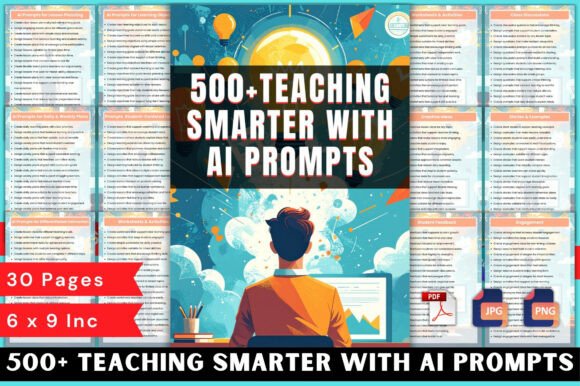
The 500 Teaching Smarter with AI Prompts guide is structured around four key areas: lesson planning, content creation, assessment and feedback, and classroom management. Each section contains short, clear, and ready-to-use prompts that teachers can copy, paste, and adapt instantly. These prompts are not generic or vague—they are written with real classroom scenarios in mind, ensuring they align with pedagogical best practices and student needs.
Lesson Planning Instruction Prompts
Creating effective lesson plans can be time-consuming, especially when considering differentiation and student-centered approaches. The 500 Teaching Smarter with AI Prompts includes prompts that help teachers design daily and weekly lesson plans, set clear learning objectives, and implement differentiated instruction strategies. For example, a prompt might ask:
- “Generate a 60-minute lesson plan for a middle school science class on ecosystems, including formative assessment checkpoints and opportunities for student collaboration.”
- “Create a week-long unit plan for high school English, focusing on literary analysis and incorporating diverse reading materials.”
These prompts allow teachers to quickly generate comprehensive plans without starting from scratch, freeing up valuable time for other responsibilities.
Worksheets, Activities, and Content Creation
Designing engaging worksheets and classroom activities is another area where 500 Teaching Smarter with AI Prompts shines. Teachers can use the prompts to generate discussion questions, stories, examples, and visual learning materials tailored to specific subjects or grade levels. For instance, a prompt could be:
- “Develop a creative writing activity for elementary students based on a given theme, including a rubric and peer review guidelines.”
- “Generate a set of interactive math problems for 8th graders that incorporate real-world applications and include answer keys.”
By using these prompts, teachers can create varied and engaging content more efficiently, ensuring that their lessons remain dynamic and aligned with curriculum standards.
Assessment and Feedback Prompts
Assessments and feedback are critical components of the learning process, yet they can be overwhelming for educators. 500 Teaching Smarter with AI Prompts provides prompts that help teachers design fair, clear, and manageable assessments, including quizzes, tests, rubrics, and self-assessment tools. A sample prompt might be:
- “Create a rubric for a high school history project that evaluates research, analysis, and presentation skills.”
- “Generate a set of formative assessment questions for a middle school math unit on fractions, with immediate feedback options.”
These prompts ensure that assessments are both effective and efficient, allowing teachers to provide timely and constructive feedback to students.
Classroom Management and Engagement
Managing a classroom effectively requires a combination of structure, engagement, and social-emotional support. The 500 Teaching Smarter with AI Prompts includes prompts that help teachers establish routines, support student behavior, and promote inclusive practices. Examples include:
- “Develop a classroom routine for beginning-of-the-day check-ins that supports social-emotional learning.”
- “Generate a list of strategies to engage reluctant learners during group work.”
These prompts empower teachers to build positive classroom environments that foster student participation and well-being.
Strategic Use of 500 Teaching Smarter with AI Prompts
While 500 Teaching Smarter with AI Prompts offers numerous benefits, it is essential to use it strategically. Simply copying and pasting prompts without thoughtful consideration may lead to ineffective or misaligned outcomes. Instead, teachers should approach the prompts as a starting point rather than a final product.
For instance, when generating a lesson plan, a teacher might first identify the core objective and then use a relevant prompt to expand on the details. After generating the initial content, it should be reviewed and customized to fit the specific needs of the class. This ensures that the final product remains aligned with the teacher’s goals and the students’ learning needs.
Additionally, teachers should consider the context in which they are using the prompts. What works for one subject or grade level may not be suitable for another. By tailoring the prompts to their unique classroom situations, teachers can maximize their effectiveness.
Planning Tips for Using AI Prompts Effectively
To make the most of 500 Teaching Smarter with AI Prompts, consider the following tips:
- Define your goals before selecting a prompt. Are you looking to save time, improve student engagement, or develop new assessment methods?
- Review and refine the generated content. While AI can provide a solid foundation, human judgment is still crucial for customization and alignment with curriculum standards.
- Experiment with different prompts to find what works best for your teaching style and classroom dynamics.
- Track outcomes and adjust your approach over time. What worked well in one lesson may need tweaking for the next.
By following these steps, teachers can ensure that they are using AI prompts in a way that enhances their practice rather than replacing it.
Possible Risks and Considerations
Although 500 Teaching Smarter with AI Prompts can be a powerful tool, there are risks associated with its use if not approached carefully. One potential risk is over-reliance on AI-generated content without sufficient review or adaptation. This could result in lessons that are not fully aligned with student needs or curriculum expectations.
Another consideration is the importance of maintaining a personal touch in teaching. While AI can generate content efficiently, it cannot replace the nuanced understanding and relationships that teachers bring to the classroom. Therefore, it is important to balance AI-generated content with personal insights and classroom experience.
Finally, teachers should be aware of data privacy and ethical considerations when using AI tools. Ensuring that any AI-generated content complies with school policies and protects student information is essential.
Conclusion
500 Teaching Smarter with AI Prompts is more than just a collection of prompts—it is a strategic resource that empowers teachers to work smarter, not harder. By leveraging AI to streamline lesson planning, content creation, assessment, and classroom management, educators can save time, reduce stress, and focus on what truly matters: meaningful teaching and learning.
However, success with this tool depends on thoughtful and intentional use. When used with purpose and care, 500 Teaching Smarter with AI Prompts can become an invaluable asset in any teacher’s toolkit, supporting long-term growth and improved outcomes for both educators and students alike.